

TABLE OF CONTENTS
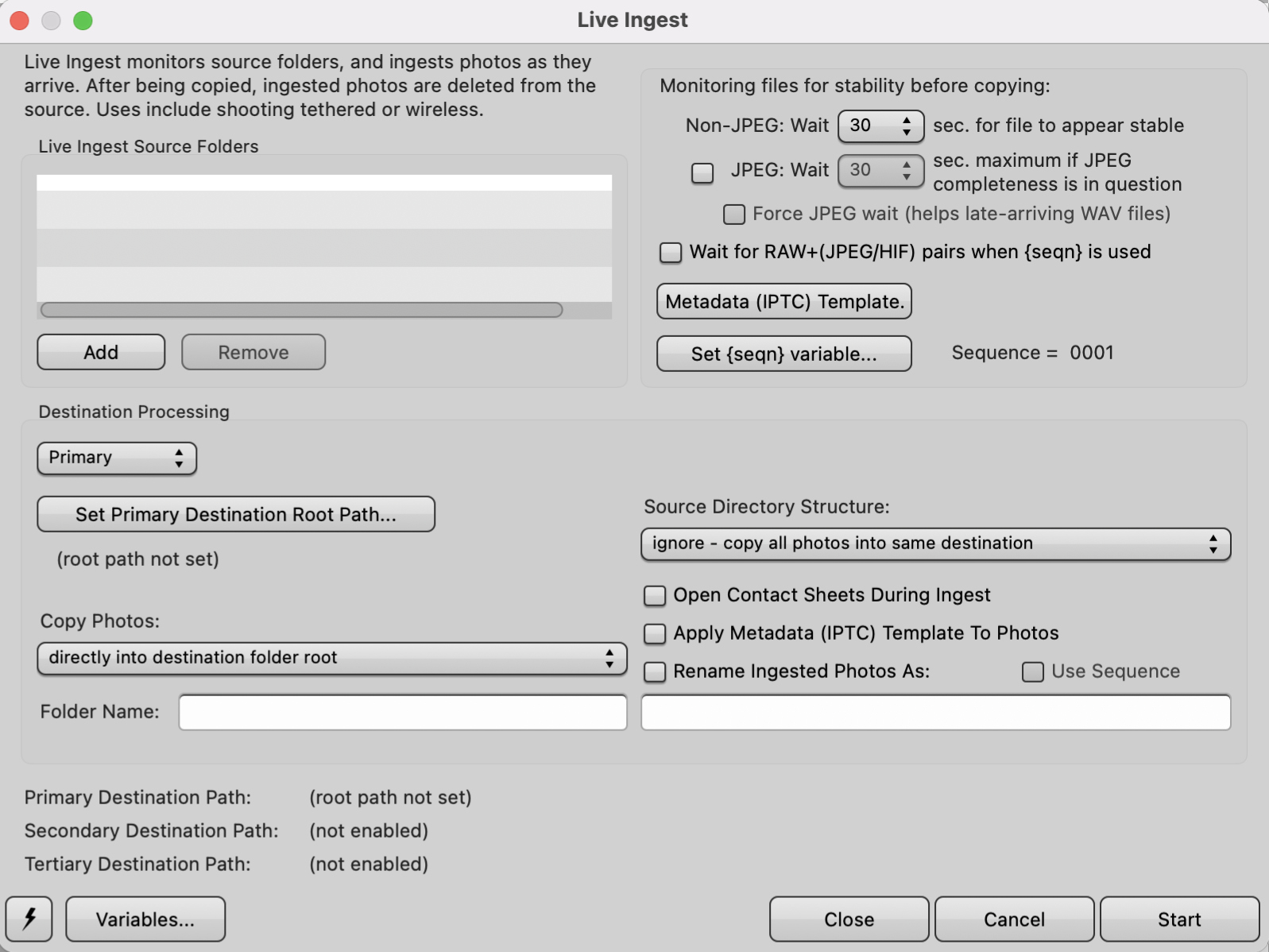
Live Ingest works similarly to a standard Ingest process, except that rather than ingesting all the photos at once, Live Ingest monitors a folder and ingests new photos that appear in it according to your specifications. This is used for tethered photography via a WiFi or hardwired Ethernet connection.
Live Ingest processes last until you close Photo Mechanic or you cancel them.
Live Ingest Source Folders
Select Add to choose one or more folders that the Live Ingest process monitors for new files.
To remove an existing folder from the list, select it, then select Remove.
Destination Processing
Dropdown menu options:
- Primary
- Secondary - when selected, select Enable to be able to set the secondary destination root path by selecting Set Secondary Destination Root Path
- Tertiary- when selected, select Enable to be able to set the tertiary destination root path by selecting Set Tertiary Destination Root Path
Set Primary Destination Root Path - Select this to open a folder picker window to choose or create the destination folder of the Live Ingest. This button will change to 'Set Secondary Destination Root Path' or 'Set Tertiary Destination Root Path' depending on the option selected in the dropdown menu above it. Use the optional secondary or tertiary destination options if you want to live ingest to multiple storage drives or multiple root folders.
Copy Photos -
- Directly into destination folder root - files are directly into the Destination Folder Root Path set above
- Into dated folder only - Photo Mechanic creates a sub-folder named as the date the live ingest is performed, formatted as YYYYMMDD inside the destination root folder
- Into folder with name - Enter text into the 'Folder Name:' textbox. You can enter plain text for the folder name as well as incorporate variables to create folder names. You can optionally use the forward slash ' / ' character on macOS or the back slash ' \ ' character on Windows to create sub-folder structures inside the Destination Root Folder.
(IE: if the Primary Destination Root Path is set to the root folder of an external drive, in the 'Folder Name' textbox you can enter /Pictures/{year4}/{datesortdash} - Event Name Here/ to create a folder structure with a sub-folder called 'Pictures', a sub-folder in it with the four digit capture year according to the images' EXIF metadata, then a sub-folder inside with the name formatted as yyyy-mm-dd using the capture year, month, and day according to the images' EXIF metadata) - Into dated folder then folder with name - A combination of the options above. Photo Mechanic creates a sub-folder named as the date the live ingest is performed, formatted as YYYYMMDD inside the destination root folder, then inside of that sub-folder, another sub-folder is created using the text entered into the 'Folder Name' textbox.
Source Directory Structure- this option determines if Photo Mechanic will keep the folder names from your memory card when it copies your files to their destination.
- Ignore - the folder structure from the source will not be copied over to the destination
- Keep Separate source folder names only - only copies just the parts of the folder structure that are separating different photos
- Preserve all source directories- copies the entire folder structure on the source drive.
Open Contact Sheets during Ingest - When selected, a Contact Sheet will open showing the files as they are live ingested into the destination folder.
Apply Metadata Template to Photos - Photo Mechanic will apply the Global Metadata (IPTC) Template during Live Ingest. Select Image->Metadata (IPTC) Template from the top menu to access the Global Metadata (IPTC) Template.
Rename Ingested Photos As -
When this option is enabled, the files copied during live ingest will be renamed according to your settings. Batch renaming is also available in the Copy/Move Photos tool and when using File Uploaders. You can take advantage of the live ingest process to rename your photos from the defaults set by your camera. You can enter text, use variables, or use a combination.
Use the Sequence option to add a number count to each filename. Specify the first number in the photo count and how to increment. We recommend starting with 001 rather than 1. Note that Photo Mechanic will default to the last number you used between ingests until you reset it.
Primary Destination Path - displays the full folder path of the Primary Destination
Secondary Destination Path - displays the full folder path of the Secondary Destination
Tertiary Destination Path - displays the full folder path of the Tertiary Destination
Monitoring Files for Stability While Copying
You can specify a delay (30 seconds is the default) before ingesting a new file to make sure the photo file has finished loading before it is ingested. This is especially important for RAW files.
We recommend selecting “Wait for RAW+(JPEG/HIF) pairs when {seqn} is used” if you are recording RAW and JPEG/HIF pairs in camera.
To transfer the color class/ratings and other metadata from JPEGs to the RAW versions, follow these steps:
- Put the two sets of files into the same folder. The filenames before the file extension should match. (IE: IMG_1234.CR3 and IMG_1234.JPG)
- Open that folder as a contact sheet
- Make sure your RAW and JPEG/HIF files are shown as a single item by selecting Combined RAW+JPEG from the View menu, or use the assigned keyboard shortcut (Defaults: ⌘-J on macOS and Ctrl-J on Windows)
- Select all with Edit>Select All or the assigned keyboard shortcut (Defaults: ⌘-A on macOS and Ctrl-A on Windows)
- Use the Update IPTC/XMP command on the Tools menu. Choose to Read IPTC/XMP from JPEG.
- Select Update.